 Kristen
Somewhere in America right now, a parent is Venmo-ing their college student $200 with the caption “food 🍕” — and leaving points on the table while they do it.
I know, because we’ve all been that parent. The monthly transfer to the child’s account is practically a rite of passage. But here’s the thing I want you to consider before the fall semester money-pipeline starts back up: that same allowance, routed through your credit card instead of Venmo, can build your child’s credit score and earn you points on money you were going to spend anyway. Same dollars. Two extra jobs.
The move is adding your child as an authorized user, and it’s one of the most underrated plays in the family points game. If I’m going to spend money, I want to always get points for it if I can!
What Actually Happens When You Add Them
When you add your child as an authorized user, the issuer sends them a real card with their name on it, attached to your account. They can spend; you get the bill; you’re legally on the hook for every charge. That last part matters, and we’ll come back to it.
But here’s the quiet magic: most major issuers report authorized-user accounts to the credit bureaus. That means your account’s history — its age, its spotless payment record, its low utilization — starts showing up on your child’s credit file. They’re building a credit score at 18, or even earlier with some issuers, without ever qualifying for anything. By the time they graduate and apply for their own first real card, they’re not a blank file. They’re walking in with years of borrowed history.
Length of credit history is about 15% of a credit score, and it’s the one ingredient money can’t buy later. An authorized user card starts that clock without your kid needing income, a credit check, or any idea what APR stands for.
The Points Math on Allowance Money
Now the part that made me write this post. Every dollar your authorized user spends earns points in your account — same as if you’d swiped the card yourself.
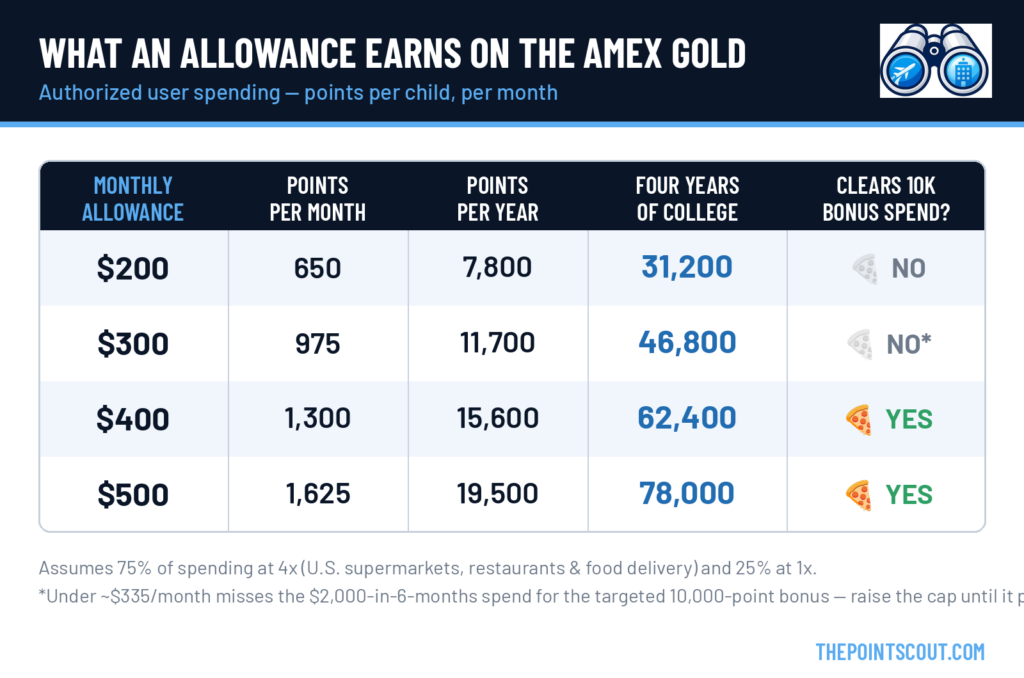
Run the numbers on, say, a $400 monthly allowance — your number might be higher or lower, but the math scales. In my experience, about 75% of a college student’s spending lands in grocery stores, restaurants, and food delivery — and yes, I checked: Uber Eats codes at 4x on the Amex Gold, which is the single most relevant fact in this post for anyone who has actually seen a college student’s transaction history. So on a Gold, that’s $300 a month earning 4x (1,200 points) and $100 earning 1x (100 points): 1,300 points a month, or about 15,600 points a year, per kid. Venmo that same $4,800 and it earns exactly nothing.
Over a four-year college run, one child’s allowance quietly stacks up to more than 62,000 Membership Rewards — a transatlantic flight in economy with points to spare, or a serious dent in one up front.
And there’s a defensive benefit hiding in here too: a credit card between your child and the world is safer than a debit card. If their card number gets skimmed at a food truck, it’s the bank’s money in dispute, not your student’s checking account.
“But Won’t They Go Crazy With It?” — The Spending Limit Question
This is the first question every parent asks, and the answer is: it depends entirely on which issuer you’re with, so check before you count on it.
American Express is the clear leader here — you can set a hard monthly spending limit on any authorized user, on any of their consumer cards, as low as $200. It’s a real cap, managed in a couple of clicks in your online account: when your student hits it, the card declines. That turns an Amex authorized user card into something remarkably close to a points-earning allowance — you’re not hoping they stop at the number you agreed on, the card stops them.
Citi offers a cap on exactly one consumer card (the Costco Anywhere Visa), and Barclays lets you limit the size of individual transactions rather than the monthly total. Capital One may be able to enable limits if you ask — worth checking in your own account. And Chase, despite being the ecosystem so many of us live in, doesn’t offer per-user spending limits on personal cards at all.
If your card can’t set a cap, you’re not out of options — you’re just managing with softer tools – and the knowledge of how your child behaves. My middle child would never go over an assigned limit – my youngest – I don’t even want to think about it! But if the spending-cap feature is the thing that makes you comfortable saying yes, that’s a genuine point in Amex’s column.
The Play We’d Run: One Amex Gold, Up to Five Kids’ Cards
So here’s my actual recommendation, start to finish.
If you don’t already have an Amex Gold, this is the card built for this job. Its bonus categories — 4x at U.S. supermarkets (up to $25,000 a year) and 4x at restaurants — happen to be a near-perfect map of how many college students spend money, mine included. And unlike most premium cards, the Gold gives you your first five additional cards at no extra fee ($35 a year each after that). Five free cards covers a whole roster: all three of our kids, with two slots to spare.
Then there’s the kicker. Amex periodically runs a targeted bonus for adding an authorized user — right now it’s 10,000 Membership Rewards points after your new card member spends $2,000 in their first six months. It’s essentially a mini welcome bonus for a card you were adding anyway. Two honest asterisks: it’s targeted, so check your Amex Offers section or log in and look before you count on it (amounts have floated between 5,000 and 20,000 points in different rounds), and only the first card member you add through the offer earns the bonus — five cards, one bonus, not five.

Now watch how neatly the pieces snap together — with one number to keep an eye on. The bonus requires $2,000 of spending in six months, which works out to about $333 a month. Something to consider when you are setting up the spending limit if you’d like to earn the extra sign up bonus.
Then multiply by your roster. Two kids on $400 allowances is roughly 31,200 points a year from everyday spending alone — plus the 10,000-point bonus in year one from the first card added through the offer. 41,000 Membership Rewards in year one for a two-allowance household, from money that was leaving the house anyway. I love finding ways to not leave points on the table.
Setting the limit takes about a minute in your Amex account:
- Select the Account Services tab.
- Select Manage Other Users.
- Select the Additional Card you want to edit.
- Click Set Limit — or Increase Limit or Manage Settings, if you’re adjusting one that already exists.
- Click Save Settings at the bottom right to lock it in.
And notice step 4, because it answers the question every parent is silently asking: what if there’s an actual emergency? The cap is changable within seconds. So if the car breaks down or a flight home needs booking, you raise the ceiling from your phone before your child has finished explaining. Day to day, the limit holds the budget; the moment life happens, it moves.
The Fine Print
A few honest caveats before you add anyone to anything.
You are liable for everything they spend. A spending cap or a stern conversation limits the damage, but legally, their charges are your charges.
Their spending counts against your utilization. If your kid runs up $1,000 on a card with a $10,000 limit, that’s 10% utilization on your report whether you spent a dime or not. Budget your own credit line accordingly.
Your habits become their credit file — in both directions. The whole reason this works is that your account history flows to them. Miss a payment or carry a high balance, and you’ve exported that too.
Premium cards may charge for additional users. The Gold’s first five are free, but other premium cards — including the Platinum — charge real money per additional card. Check your card’s fee before assuming.
The Bottom Line
You’re likely going to send your college student money either way. The only question is whether that money builds a credit score and a points balance on its way out the door, or evaporates into the Venmo void with a pizza emoji attached.
I know which one I am going with. I only wish I had thought of it sooner!